


If you have recently received a diagnosis of multiple sclerosis (MS), or if you have been managing the condition for years, you likely feel a mix of fear, confusion, and perhaps a sense that you are losing control over your own body. I understand that fear. As a board-certified neurologist and functional medicine practitioner, I have sat across from countless patients who are terrified that their diagnosis is a fixed destiny.
In the traditional medical model, you are often told that multiple sclerosis is a permanent, progressive condition where the best we can hope for is to slow the decline. But I am here to tell you that your genes are not your destiny. At Sharlin Health and Neurology in Springfield, MO, we believe that while we cannot change your genetics, we can absolutely change the environment in which those genes live.
When we discuss multiple sclerosis symptoms and treatment, we have to go beyond just suppressing the immune system. We have to ask why the immune system is misbehaving in the first place. By combining the precision of modern neurology with the investigative power of functional medicine, we can create a roadmap not just for survival, but for revitalization.
What Is Multiple Sclerosis?
To take control of your health, you first need to understand what is happening inside your Central Nervous System (CNS).
Multiple sclerosis is an autoimmune condition where the body’s immune system mistakenly attacks the myelin sheath. Think of your nerves like electrical wires; the myelin is the rubber insulation that ensures the signal gets from Point A to Point B safely and quickly. When this insulation is damaged by inflammation, it creates scar tissue or sclerosis. This disrupts the communication between your brain and the rest of your body.
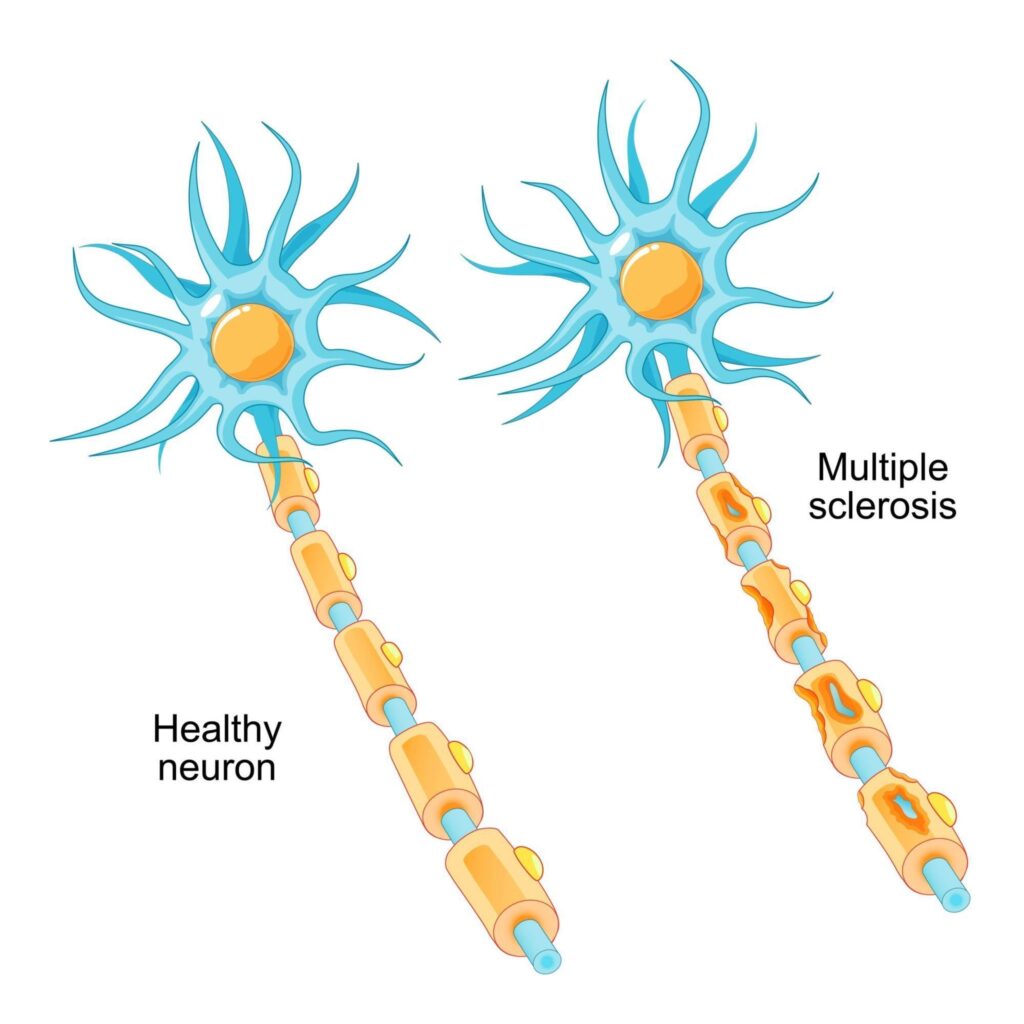
Source: Getty Images
However, we need to look deeper. Why does the immune system attack the myelin? In my practice, we view MS not just as “bad luck,” but as a result of a mismatch between your biology and your environment. Factors like mitochondrial dysfunction, systemic inflammation, environmental toxins, and nutrient deficiencies all play a role in “pulling the trigger” on the disease.
Recognizing the Signals: Multiple Sclerosis Symptoms
The symptoms of multiple sclerosis are the body’s way of raising a red flag. Because the CNS controls everything from your movement to your thoughts, MS can present in a myriad of ways. No two patients have the exact same “fingerprint” of the disease, but there are common threads we look for.
Identifying these early signs is critical. The sooner we can identify the dysfunction, the sooner we can intervene, not just with medication, but with lifestyle changes that calm the fire of inflammation.
Physical Red Flags
- Fatigue: This is the most debilitating complaint I hear. It is not just being tired; it is a profound, bone-deep exhaustion that doesn’t improve with rest.
- Numbness and Tingling: You might feel a “pins and needles” sensation in your hands, feet, or face. This is often the first sign that the nerves are struggling to conduct signals.
- Vision Problems: Inflammation of the optic nerve (optic neuritis) is a hallmark of MS. You might experience blurred vision, pain when moving your eyes, or double vision.
- Muscle Spasms and Stiffness: Spasticity can make your legs feel heavy or stiff, affecting your ability to walk fluidly.
- Balance and Coordination: If the cerebellum is affected, you might feel dizzy or unsteady, as if you are on a boat.
Cognitive and Emotional Impact
We cannot talk about multiple sclerosis symptoms without discussing the brain itself.
- Cognitive Changes: Many of my patients describe “brain fog”—trouble finding words, difficulty multitasking, or feeling like their thinking speed has slowed down.
- Mood Changes: Depression and anxiety are not just reactions to the diagnosis; they are symptoms of the neuroinflammation occurring in the brain.
If you are noticing a pattern of these symptoms, it is time to seek a comprehensive evaluation. But remember: a diagnosis is a label, not a verdict.
The “Brain Tune Up!” Approach to Treatment

When patients come to see me for multiple sclerosis treatment in Springfield, MO, they often expect to just be handed a prescription. And yes, as a medical doctor, I can and do prescribe medications when they are necessary. But if all you do is take a pill, you are missing the biggest opportunity to change the trajectory of your life.
At Sharlin Health and Neurology, we use our proprietary “Brain Tune Up!” protocol. This is an investigative process where we look at the “root cause” drivers of your condition.
1. Identify and Investigate
We don’t just guess; we test. We use advanced diagnostics that go far beyond standard lab work. We look at your gut microbiome, your hormone levels, your exposure to toxins, and your genetic markers. We are looking for the specific imbalances that are fanning the flames of your autoimmunity.
2. Restore and Regenerate
Once we know what is broken, we fix it. This is where true therapy begins. We focus on restoring your body’s ability to heal itself. This might involve targeted nutritional support to repair the myelin sheath, protocols to support your mitochondria (the energy engines of your cells), and strategies to detoxify your system.
Conventional Multiple Sclerosis Treatment Options
It is important to understand the conventional tools in the toolbox, as they play a critical role in the management of multiple sclerosis. While well-powered clinical trials have established the effectiveness of these drugs in slowing disability progression and relapse rate, as well as reducing the appearance of new lesions in the brain, my goal is to make sure that each person with MS is treated as an individual.
Part of the equation is to determine if using Disease-Modifying Therapy (DMT) is right for you, and if so, which one makes the most sense. I can also track your response to treatment over time and determine whether the drug is working before new lesions appear in your brain or spinal cord. In other words, if there’s a problem, I can anticipate where things are going and make a change before a small fire turns into a blaze that burns the whole house down.
Disease-Modifying Therapies (DMTs):
These are the standard pharmaceutical treatment options for MS. They work by suppressing specific parts of the immune system to reduce relapses and prevent new lesions from forming on your MRI.
- Injectable medications: older, well-understood drugs.
- Oral medications: convenient pills that modulate immune response.
- Infusion therapies: stronger drugs delivered intravenously for active disease.
While DMTs can be effective at stopping attacks, they do not repair the damage that has already been done, and they do not address why you are sick. That is why relying on them alone is an incomplete strategy.
The Functional Medicine Difference
(Note: This video provides a personal look at my philosophy and how our “Brain Tune Up!” protocol integrates neurology and functional medicine to treat complex conditions like MS.)
In my practice, we integrate treatment by using food, sleep, movement, and stress management as medicine. This is not “soft science”; this is biochemistry.
- Nutrition: We use food to lower inflammation. For multiple sclerosis, this often means removing inflammatory triggers like gluten and dairy and flooding the body with phytonutrients that protect the brain.
- Sleep: Your brain cleans itself while you sleep. Prioritizing deep, restorative sleep is non-negotiable for MS
- Movement: Exercise increases Brain-Derived Neurotrophic Factor (BDNF), which acts like “Miracle-Gro” for your brain cells.
- Stress: High cortisol levels destroy the brain. We teach you active tools to manage stress, shifting your nervous system from “fight or flight” to “rest and digest.”
Local Care: Multiple Sclerosis in Springfield, MO

Living with multiple sclerosis requires a team. You need a partner who understands the complexities of the nervous system and is willing to take the time to listen to your story.
In Springfield, MO, you have choices. But you need to ask yourself: Do you want a doctor who simply manages your decline, or do you want a partner who will fight for your recovery? At Sharlin Health and Neurology, located just minutes from Springfield in Ozark, we serve patients from all over the Ozarks who are ready for a different answer.
We also encourage our patients to utilize the rich community resources available in the Springfield, MO area:
- Adaptive Movement: Look for yoga studios or aquatic centers in Springfield that offer low-impact classes. Keeping your body moving without overheating is vital.
- Community Support: While we offer a supportive environment within our clinic, connecting with local support groups can help you feel less isolated.
Types of MS and Prognosis
Understanding which form of Multiple Sclerosis you have helps us tailor your treatment options.
- Relapsing-Remitting MS (RRMS): Characterized by clearly defined attacks of new or increasing neurologic symptoms. These attacks (also called relapses or exacerbations) are followed by periods of partial or complete recovery (remissions).
- Secondary-Progressive MS (SPMS): A stage where symptoms worsen more steadily over time, with or without relapses.
- Primary-Progressive MS (PPMS): Accumulation of disability from the onset, without early relapses or remissions.
Regardless of the “type” you have been assigned, the functional medicine principles remain the same: remove the interference, provide the necessary building blocks, and let the body heal.
When to Seek Help for Multiple Sclerosis
If you are experiencing unexplained numbness, vision problems, or persistent fatigue, do not ignore it. Early diagnosis is a powerful tool. Furthermore, if you are already under care but feel that your current plan is just “treading water,” it might be time for a second opinion.
You should consult a neurologist in Springfield if:
- You have new symptoms that last more than 24 hours.
- You are experiencing side effects from your medication that affect your quality of life.
- You want to explore how nutrition and lifestyle can enhance your current treatment.
Final Words – A Message of Hope
I founded Sharlin Health and Neurology because I was tired of seeing patients being told there was “nothing else to be done.” There is always something else to be done. The science of neuroplasticity (the brain’s ability to rewire and heal itself) is on our side.
By addressing the root causes of inflammation and optimizing your biology, you can live a vibrant, full life with multiple sclerosis. We have seen it happen in our clinic time and time again. You do not have to settle for a life of diminishing returns.
If you are ready to dig deeper, to ask “why,” and to take an active role in your multiple sclerosis treatment plan, I invite you to reach out to us. We are here to serve the Springfield, MO community with a level of care that is as unique as you are.
Let’s find your path to better brain health together.