

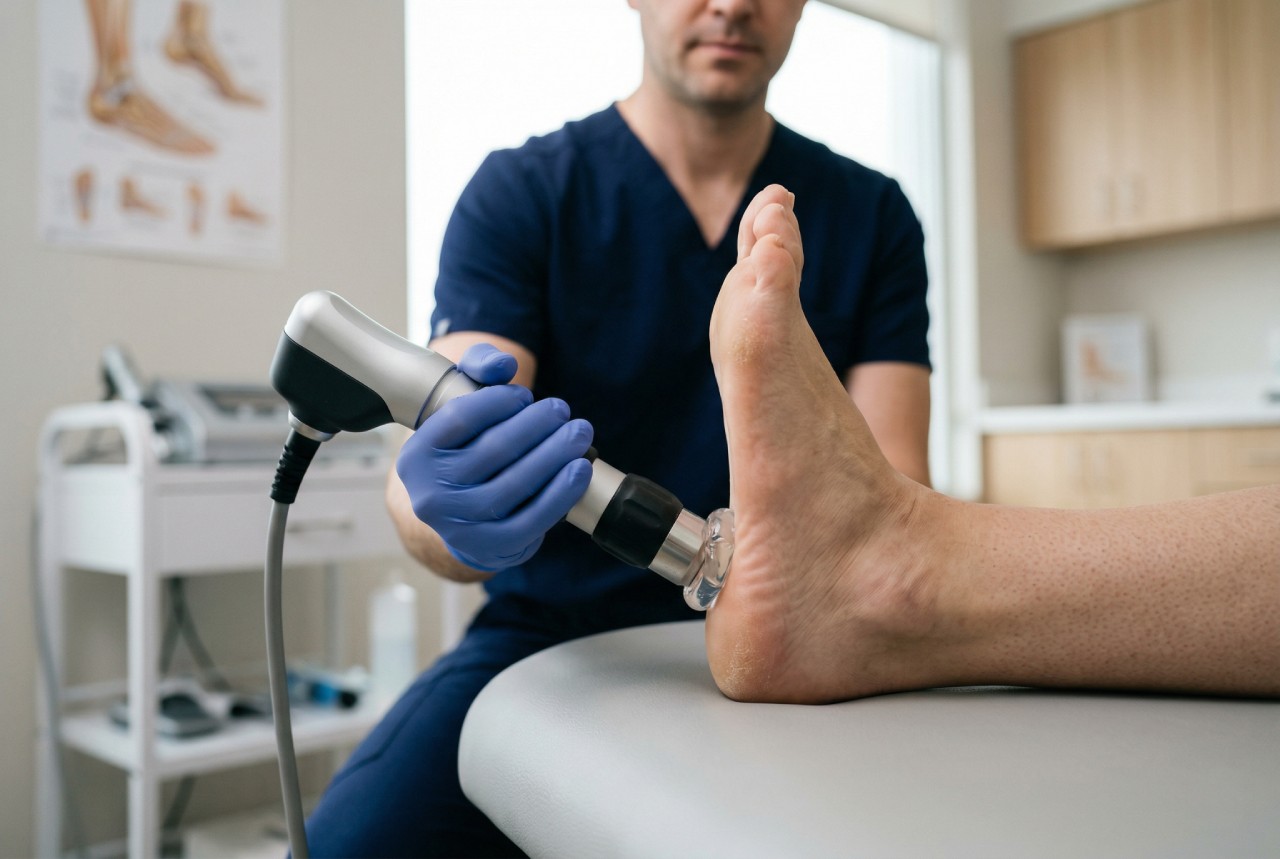
If you’ve ever struggled with plantar fasciitis, you know how much it can interfere with your daily life.
That sharp, stabbing pain in your heel, especially with your first steps in the morning, can make something as simple as walking feel like a challenge.
I see this frequently in my clinic here in Springfield, Missouri, in everyone from runners and active individuals to professionals who spend long hours on their feet. Even patients who are trying to improve their health through walking programs can find themselves sidelined by persistent heel pain.
When people start looking for solutions, they often come across shockwave therapy for plantar fasciitis, and there’s a reason this has gained so much attention. It reflects a shift away from temporary relief toward supporting the body’s actual healing process.
📋What You’ll Learn in This Article
Before we get into the details, here’s a quick look at what you’ll walk away with:
- What plantar fasciitis really is and why heel pain can become chronic
- Why standard treatments like rest, stretching, and anti-inflammatory options often fall short
- How shockwave therapy works and what extracorporeal shockwave therapy actually does inside the tissue
- The difference between radial and focused shockwave, and why that matters for results
- What to expect during treatment, including comfort level and whether anesthesia is needed
- How shock waves help restart the healing process in damaged plantar fascia
- Who is a good candidate for shockwave therapy for plantar fasciitis
- How this approach fits into a broader musculoskeletal treatment plan for long-term relief
Understanding Plantar Fasciitis at Its Core
To understand why shockwave therapy is effective, it helps to first understand what plantar fasciitis really is.
The plantar fascia is a thick band of connective tissue that supports the arch of your foot. Over time, repetitive stress can create small areas of damage. Despite the term “fasciitis,” what I often see clinically is not just inflammation but a chronic, degenerative condition involving the plantar fascia.
Research published in journals such as The American Journal of Sports Medicine and Foot & Ankle International has shown that plantar fasciitis often reflects a failed healing response rather than an actively inflamed state. This helps explain why anti-inflammatory treatments alone do not always resolve symptoms.
This is why many patients find that rest, stretching, orthotics, or anti-inflammatory medications only provide partial or temporary relief. The underlying issue, impaired tissue repair, has not been addressed.
What Is Shockwave Therapy and How Does It Work?
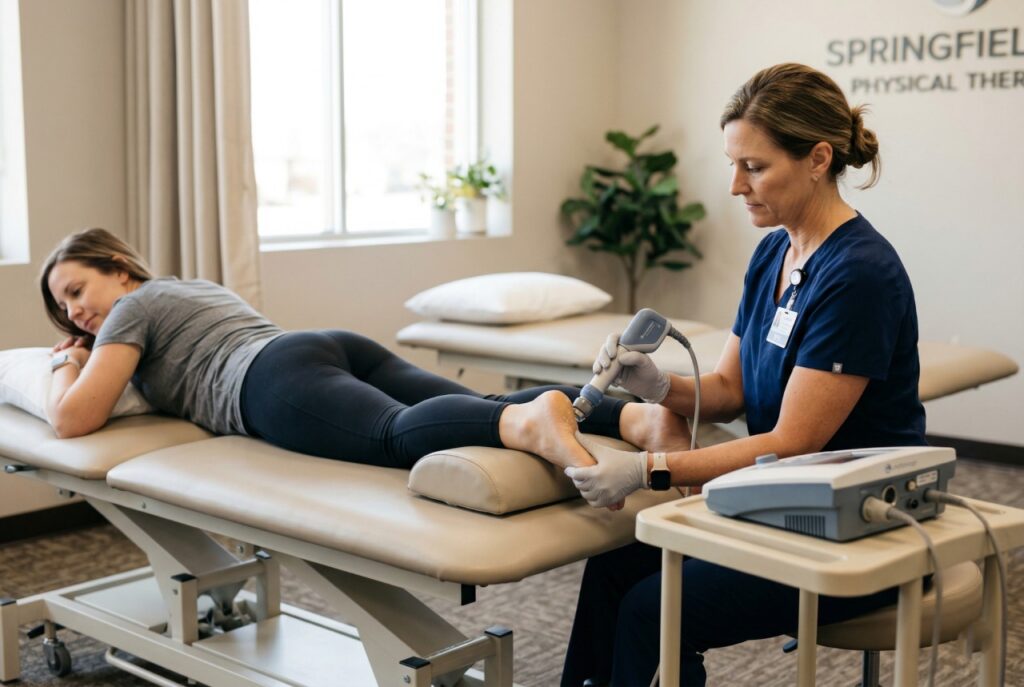
This is where shockwave therapy for plantar fasciitis becomes so valuable.
Extracorporeal shock wave therapy, often abbreviated as ESWT, uses acoustic shock waves to stimulate the body’s natural healing response. This is not an electrical shock, and it does not involve needles, anesthesia in most cases, or surgery.
Instead, extracorporeal shockwave therapy delivers mechanical energy through the skin into the affected musculoskeletal tissue. These shock waves:
- Increase blood circulation to the heel
- Stimulate cellular repair activity
- Promote collagen production in the plantar fascia
- Help restart a stalled healing process
Clinical studies, including systematic reviews in The Journal of Orthopaedic Research, have demonstrated that shockwave therapy can significantly reduce heel pain and improve function in patients with chronic plantar fasciitis, especially when symptoms have persisted for more than six months.
Why Shockwave Therapy Targets the Root Cause
What makes shockwave therapy particularly effective is that it does not simply mask symptoms.
Instead of focusing only on reducing inflammation, it works at a deeper level by stimulating regeneration. This is important because chronic plantar fasciitis is often less about tissue being actively inflamed and more about tissue that has failed to heal properly.
In my experience, many patients who have been dealing with heel pain for months or even years begin to see meaningful improvement once we activate this biological repair response.
Not All Shockwave Devices Are the Same
One of the most important points that is often overlooked is that not all shockwave therapy is the same.
Broadly speaking, there are two types of systems:
- Radial shockwave: disperses energy over a wider area and is less targeted
- Focused shockwave: delivers energy at a precise depth and location
Radial systems can be helpful in some cases, but they often lack the precision needed for deeper or more specific areas of tissue damage.
Focused extracorporeal shock wave therapy allows for a more targeted approach, which is especially important in plantar fasciitis, where degeneration often occurs in specific points along the plantar fascia near the heel.
Advanced Shockwave Technology at Sharlin Health & Neurology
At Sharlin Health & Neurology, we use the Piezowave 2T system, which represents one of the most advanced forms of focused shockwave therapy available.
This system uses piezoelectric technology to generate highly controlled shock waves. The benefit is precision. We can target the exact area of dysfunction within the plantar fascia with a level of accuracy that is not possible with more generalized systems.
Why does that matter?
Because plantar fasciitis is not a diffuse condition. It often involves localized degeneration. When we can precisely target those areas, we can deliver the right amount of energy without affecting surrounding tissue.
This often leads to:
- More efficient treatments
- Improved patient comfort
- Better clinical outcomes
Another key advantage is customization. We can adjust both depth and intensity based on the individual, which is critical since no two cases of plantar fasciitis are exactly the same.
What to Expect During Shockwave Treatment

When patients come in for shockwave therapy for plantar fasciitis in our Springfield clinic, they often ask what it feels like.
Most describe it as a tapping or pulsing sensation over the heel. If the area is particularly sensitive, there can be mild discomfort, but it is typically well tolerated. In most cases, anesthesia is not required.
Each session usually lasts about 10 to 15 minutes. Treatments are spaced about a week apart to allow the body time to respond and progress through the healing process.
Recovery, Results, and Long-Term Outcomes
One of the biggest advantages of shockwave therapy is that there is little to no downtime.
You can return to normal daily activities the same day, although we guide you on how to avoid overloading the plantar fascia while it heals.
Over the following weeks, as blood flow improves and tissue repair progresses, most patients notice:
- Reduced heel pain
- Improved mobility
- Better tolerance for walking and activity
Multiple randomized controlled trials have shown sustained improvement in pain and function for patients undergoing extracorporeal shockwave therapy compared to placebo or standard conservative care.
A Comprehensive Approach to Plantar Fasciitis
It’s important to understand that shockwave therapy works best as part of a broader treatment strategy.
We evaluate contributing factors such as:
- Foot mechanics
- Calf tightness
- Footwear choices
- Activity patterns
By addressing these alongside targeted shockwave therapy, we can improve outcomes and reduce the likelihood of recurrence.
Why More Patients Are Choosing Shockwave Therapy
Here in Springfield, Missouri, I’ve seen a growing number of patients seek out shockwave therapy for plantar fasciitis because they want a solution that is:
- Non invasive
- Regenerative
- Focused on long-term healing
Many are looking to avoid injections, prolonged medication use, or surgery. Shockwave therapy offers a path that aligns with those goals while still being grounded in evidence-based musculoskeletal care.
FAQs: Shockwave Therapy for Plantar Fasciitis
1. How effective is shockwave therapy for plantar fasciitis?
Shockwave therapy has strong clinical support for chronic plantar fasciitis, especially when symptoms have lasted more than six months. Many patients experience significant reductions in heel pain and improved function after a series of treatments.
2. Does shockwave therapy hurt?
Most patients describe the sensation as mild to moderate discomfort, similar to a tapping feeling on the heel. It is generally well tolerated, and anesthesia is usually not needed.
3. How many sessions of ESWT are needed?
A typical treatment plan involves three to five sessions spaced about one week apart. The exact number depends on the severity of the plantar fasciitis and how your body responds.
4. Is extracorporeal shockwave therapy safe?
Yes, extracorporeal shockwave therapy is considered safe when performed by trained providers. It is non-invasive and has a low risk of complications compared to surgical options.
5. How long does it take to see results from shockwave therapy?
Some patients notice improvement within a few weeks, while others see gradual changes over several months as the healing process continues. Results tend to build over time rather than happen instantly.
Conclusion: A Smarter Way to Treat Heel Pain
If you’re dealing with ongoing heel pain, it may be time to ask a different question.
Instead of asking, “What can I do to get through the day with less pain?” consider asking, “What does my body need to actually heal this?”
Plantar fasciitis can be stubborn, but it is not something you have to live with indefinitely. With the right approach and with advanced tools like extracorporeal shock wave therapy, it is often possible to reduce pain, restore function, and return to normal activity.
If you are exploring shockwave therapy for plantar fasciitis in Springfield, Missouri, schedule a consultation with Sharlin Health & Neurology. A personalized evaluation can help determine if this treatment is the right fit for your condition and recovery goals.
