


For much of modern neurology, the practice of medicine has followed a familiar pattern. A patient develops symptoms, sees a neurologist, undergoes an examination and perhaps an MRI or another diagnostic study, receives a diagnosis, and then begins treatment.
Several months later, the patient returns, and we ask how they are doing. We repeat portions of the examination, review symptoms and medications, occasionally repeat imaging, and decide whether to continue what we are doing or make a change.
There is nothing inherently wrong with this approach. In fact, it has been the foundation of neurological practice for decades. But it is increasingly incomplete.
At Sharlin Health and Neurology, we have tried to practice differently. For years, we have been incorporating the principles of precision medicine into neurological care, not simply to better define a diagnosis, but to answer a much more important question:
Is the treatment strategy we have chosen actually changing the trajectory of the disease?
That distinction is central to how I think about the future of neurology.
The traditional neurological model is very good at identifying disease. It can tell us that someone has multiple sclerosis, Alzheimer’s disease, Parkinson’s disease, migraine, epilepsy, or another neurological condition.
What it has historically been much less capable of doing is measuring the biology of that disease over time. We may know what disease a person has, but still have limited information about whether that disease is biologically quiet or active at a particular moment, whether the treatment strategy is having the intended effect, or whether two patients with the same diagnosis have very different biological processes driving their illness.
That is beginning to change.
What You’ll Learn From This Article
In this first part of the series, I will explain:
- How precision medicine changes the questions we ask in neurological care
- Why diagnosis alone may not tell us enough about disease activity
- How blood-based biomarkers are being incorporated into multiple sclerosis care
- What the Octave Multiple Sclerosis Disease Activity Test can and cannot tell us
- Why repeated measurements can be more informative than a single laboratory result
- How Alzheimer’s disease is increasingly being defined through its underlying biology
- What research on p-tau217 and other Alzheimer’s biomarkers is showing
- Why biomarkers should complement, rather than replace, neurological examination, imaging, and clinical judgment
Moving Beyond the Traditional Neurology Visit

Precision neurology begins by changing the objective of the clinical encounter.
I sometimes use the term “corporate neurology” to describe the conventional model, although I do not mean that as a criticism of individual neurologists working within large systems. There are excellent physicians practicing in major institutions throughout the country.
The problem is that the system itself is frequently built around volume, diagnosis, medication management, documentation, and compliance rather than deep biological investigation.
The average neurological visit may give the physician a limited amount of time to review medications, discuss symptoms, perform an examination, look at imaging, document the encounter, address insurance requirements, and prepare for the next patient.
Within that model, a critical question can receive less attention:
Can we measure what the disease itself is doing?
Precision Medicine Asks a Different Set of Questions
Instead of simply asking whether someone has multiple sclerosis, we can begin asking how active the disease appears to be right now.
Instead of diagnosing Alzheimer’s disease only after significant cognitive symptoms appear, we can increasingly examine biological markers associated with the disease process.
And instead of assuming that a treatment is working because a patient has not experienced an obvious clinical decline, we can look for additional objective information that may help us assess what is happening underneath the symptoms.
This is not about ordering more tests for the sake of collecting data.
It is about choosing measurements that can add meaningful information to clinical decision-making.
Multiple Sclerosis: Measuring Disease Activity Between MRI Scans
Multiple sclerosis provides a useful example of how this approach can work in practice.
Several years ago, we began incorporating the Octave Bioscience Multiple Sclerosis Disease Activity Test, or MSDA Test, into our multiple sclerosis practice.
The MSDA is a serum-based assay that measures 18 proteins and uses them to calculate biological pathway scores along with an overall disease activity score. The pathways assessed include processes related to immunomodulation, neuroinflammation, myelin biology, and neuroaxonal integrity. The assay has undergone analytical and clinical validation.
Symptoms and Disease Activity Are Not Always the Same Thing
Traditionally, multiple sclerosis has been followed through a combination of symptoms, neurological examination, and MRI. Those tools remain essential.
But symptoms do not always directly reflect inflammatory disease activity.
A patient can feel substantially worse without necessarily having a new inflammatory MS event. At other times, clinicians may detect new inflammatory activity before a patient reports a dramatic neurological change.
This creates a common clinical problem.
A patient may call the office and say:
“My MS is flaring.”
The question I want to answer is not simply whether the patient feels worse. I also want to understand whether the disease appears to be biologically more active or whether another process may be amplifying neurological symptoms that already exist.
That distinction can affect what we do next.
What the MSDA Test Adds
The MSDA Test gives us another objective data point.
It does not replace MRI. It does not replace the neurological examination. And I would not interpret the result in isolation.
What it can do is help us place the rest of the clinical picture into context.
In a 2023 clinical validation study led by Tanuja Chitnis, MD, researchers evaluated the MSDA Test against radiographic measures of MS disease activity. Patients with moderate or high MSDA scores had substantially greater odds of having at least one gadolinium-enhancing MRI lesion than patients with low scores. High scores were also strongly associated with having multiple enhancing lesions.
That does not mean that a blood test tells us everything an MRI can tell us.
It means the biology measured in the blood appears to contain clinically relevant information about MS disease activity.
A low disease activity score, considered alongside a stable examination and other findings, may add reassurance that significant inflammatory activity is less likely. An unexpectedly elevated score may give us a reason to investigate more closely, consider earlier imaging, review the current therapeutic strategy, or look more carefully for evidence that a disease we believed was stable may be active.
That is a much more informative discussion than simply asking, “Do you feel better or worse?”
Why Longitudinal Measurement Matters

A major part of precision medicine is not simply what we measure. It is how we follow those measurements over time.
A single laboratory result is a snapshot. A sequence of measurements can begin to show a trajectory.
A Trend Can Be More Informative Than One Number
Suppose a patient with multiple sclerosis has a low disease activity score and remains clinically stable. That information can add confidence to the overall assessment.
Now suppose the score begins to rise on repeated testing.
That does not automatically mean the treatment has failed. But it may make me look more carefully at the patient’s examination, symptoms, imaging, medication adherence, and other clinical information.
The reverse can also be valuable.
If a patient has recently changed therapy, repeated objective measurements may help us determine whether the biological picture is moving in the direction we hoped it would.
Research on other blood biomarkers in MS supports this broader idea. Studies of serum neurofilament light chain, for example, have found associations between higher levels and subsequent clinical or MRI disease activity. This has helped strengthen interest in using blood biomarkers alongside conventional monitoring.
What We Are Learning From Real World MSDA Use
A 2025 retrospective study examined 352 patient charts and evaluated how MSDA results affected clinical decisions. Treatment plans changed after approximately 19 percent of MSDA tests, and clinicians reported a greater influence on decision-making when repeated longitudinal results were available compared with a single result. The authors emphasized that the MSDA was used in addition to standard neurological care, not instead of it.
That last point is critical.
The test should not decide treatment for us.
Clinical judgment remains essential.
But objective biological measurements can give us something neurologists have historically had relatively little of between major clinical events and MRI scans: another window into what the disease may be doing.
In chronic neurological disease, that matters.
Waiting until a patient becomes clearly worse before questioning whether a strategy is working is not ideal if we have reliable tools that can help us look earlier.
Alzheimer’s Disease Is Becoming an Increasingly Biological Diagnosis
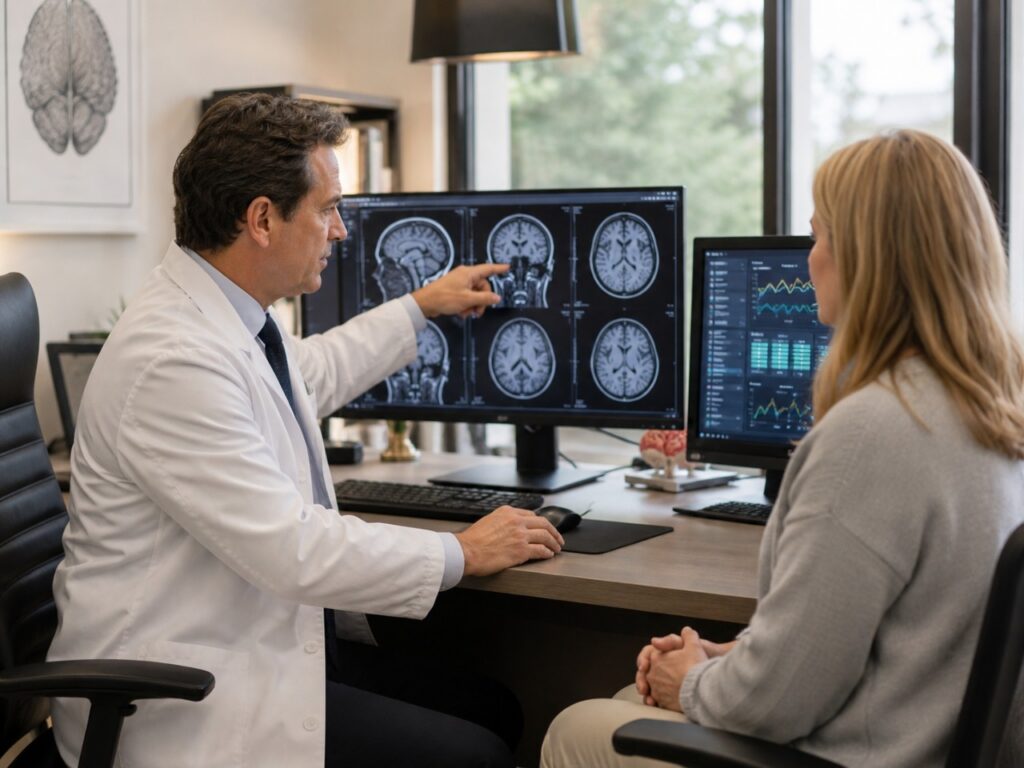
We have taken a similar approach to Alzheimer’s disease.
For several years, Sharlin Health and Neurology has incorporated blood-based biomarkers into the evaluation of selected patients with cognitive decline, before these tests became a routine part of the larger neurological discussion.
This matters because Alzheimer’s disease is not simply memory loss.
The biological processes associated with Alzheimer’s can develop well before major cognitive impairment becomes clinically obvious. Longitudinal studies have shown that amyloid- and tau-related changes may precede significant symptoms by years.
By the time substantial cognitive impairment becomes obvious, the underlying pathological process may already be well established.
Moving From Symptoms Toward Biology
Historically, demonstrating Alzheimer’s pathology often required amyloid PET imaging or analysis of cerebrospinal fluid obtained through lumbar puncture.
Those approaches remain important.
But blood-based biomarkers are giving neurologists another way to investigate the biology underlying cognitive symptoms.
One of the most extensively studied is plasma phosphorylated tau 217, commonly written as p-tau217.
A major 2024 study published in JAMA Neurology found that a commercially available plasma p-tau217 assay identified biological Alzheimer’s disease with diagnostic performance comparable to cerebrospinal fluid biomarkers across the studied cohorts. The researchers also found that p-tau217 changed longitudinally, including during early stages of the disease process.
Another 2024 study involving patients evaluated in primary and secondary care found that blood biomarker approaches centered on p-tau217 achieved approximately 88 to 92 percent diagnostic accuracy across four cohorts of people with cognitive symptoms.
These findings help explain why blood-based Alzheimer’s biomarkers have moved so quickly from research into specialty clinical practice.
The Definition of Alzheimer’s Disease Is Changing
The 2024 revised criteria for Alzheimer’s disease diagnosis and staging placed greater emphasis on biological markers of amyloid and tau pathology. The criteria identified validated plasma biomarkers, particularly p-tau217, among the tools that may help establish the biological presence of Alzheimer’s disease when appropriate performance standards are met. (PubMed)
Clinical guidance has become more specific since then.
The Alzheimer’s Association’s 2025 clinical practice guideline states that, among people with cognitive impairment being evaluated in specialized memory care, blood biomarker tests meeting defined sensitivity and specificity thresholds may be used for triage. Tests meeting higher performance thresholds may, in appropriate circumstances, serve as substitutes for amyloid PET or cerebrospinal fluid biomarker testing. (PubMed)
That does not mean every patient with memory concerns should receive a blood biomarker test.
It also does not mean that one abnormal blood test provides every answer.
But it represents a significant shift.
We are moving from diagnosing Alzheimer’s disease primarily according to what a patient can no longer remember toward identifying the biology associated with the disease itself.
To me, that is one of the most important developments in modern neurology.
Diagnosis Should Be the Beginning of the Conversation
At Sharlin Health and Neurology, our philosophy has always been that the diagnosis should be the beginning of the conversation, not the end of it.
It is useful to know that someone has multiple sclerosis.
But I also want to know how active that disease appears to be, whether the overall clinical picture is stable, and whether the current therapeutic strategy continues to make sense.
It is useful to know that someone has Alzheimer’s disease.
But I also want to understand the underlying biological pathology, the factors that may be contributing to the patient’s cognitive condition, and how those measurements fit into the larger clinical picture.
That requires combining traditional neurological expertise with biomarkers, imaging, clinical outcome measures, laboratory information, careful history taking, and repeated observation over time.
Biomarkers Add Information, Not Certainty
No laboratory test replaces clinical judgment.
No biomarker should be interpreted in isolation.
A change in a laboratory value does not automatically mean that a disease has been reversed. Nor does it prove that one particular intervention caused the change.
Similarly, a reassuring biomarker result does not mean that a patient’s symptoms should be dismissed.
The purpose of precision medicine is not to reduce a human being to a laboratory number.
It is to combine the patient’s lived experience with better biological information.
That is an important distinction.
Objective measurements can sharpen our questions. They can help us recognize patterns. They can sometimes tell us when the biological story does not match what we expected.
But the physician still has to interpret the whole story.
Frequently Asked Questions About Precision Neurology
1. What Is Precision Neurology?
Precision neurology uses information about an individual patient’s symptoms, examination, imaging, biomarkers, medical history, and other biological data to better understand their neurological disease and guide clinical decisions.
The goal is not simply to assign a diagnosis. It is to understand how that disease may be behaving in the individual patient.
2. Does the MSDA Test Replace an MRI for Multiple Sclerosis?
No. The MSDA Test provides biological information from a blood sample, while MRI allows neurologists to visualize lesions and other changes within the central nervous system.
Current evidence supports using the MSDA as an additional source of information alongside clinical assessment and imaging rather than as a replacement for them.
3. What Does the MSDA Test Measure?
The MSDA Test measures 18 proteins associated with biological processes relevant to multiple sclerosis. Its algorithm produces pathway scores and an overall disease activity score intended to help quantify current disease activity.
The result must still be interpreted in the context of the patient’s symptoms, examination, treatment history, and imaging.
4. Can a Blood Test Diagnose Alzheimer’s Disease?
Certain blood biomarkers can provide strong evidence of Alzheimer’s pathology, particularly p-tau217-based tests that meet validated performance standards.
Current clinical guidance supports their use primarily in appropriately evaluated patients with cognitive impairment, particularly within specialty care. Depending on the test, result, and clinical situation, additional testing such as amyloid PET or cerebrospinal fluid analysis may still be appropriate.
5. Why Repeat Biomarker Testing Over Time?
Repeated testing can show whether a biomarker is remaining stable, increasing, or decreasing. That trend may provide information that a single measurement cannot.
Longitudinal biomarker research in both MS and Alzheimer’s disease is increasingly examining how changes over time relate to disease activity, future clinical change, and treatment monitoring.
6. Can Biomarkers Prove That a Treatment Is Working?
Not by themselves. A biomarker may provide evidence that a biological process is changing, but determining whether a treatment is effective requires interpretation alongside symptoms, neurological examination, imaging, functional outcomes, treatment history, and other clinical information.
This is one of the most important principles of precision medicine.
Conclusion: From Naming Disease to Measuring Disease
Medicine has spent much of the last century becoming increasingly sophisticated at naming disease. The next phase of medicine will increasingly be about measuring disease.
For neurologists, that changes the conversation.
Instead of stopping at, “What disease does this patient have?” we can begin asking:
How active is it?
What is changing?
Are the clinical findings and the biological findings telling us the same story?
And is the strategy we have chosen moving that biology in the direction we want?
We cannot answer every one of those questions perfectly yet. But we can answer more of them than we could even a few years ago.
That is why I believe precision medicine represents such an important direction for neurology. Nowhere is that shift more interesting than in Parkinson’s disease.
In Part 2, I will discuss why Parkinson’s may be the next major frontier in precision neurology, how tests such as Syn One are already changing the diagnostic conversation, and how emerging blood-based biomarkers may eventually let us track aspects of disease biology and treatment response in ways that were previously not possible.
