

In Part 1, I discussed how precision medicine is changing the way we think about neurological disease. The goal is no longer simply to make a diagnosis and then follow symptoms over time. Increasingly, we can ask a more sophisticated question:
What is happening biologically, and is our therapeutic strategy actually changing it?
We are already beginning to ask this question in multiple sclerosis through blood-based disease activity testing and in Alzheimer’s disease through biomarkers associated with amyloid and tau pathology.
Parkinson’s disease may be the next major frontier.
For generations, Parkinson’s disease has remained largely a clinical diagnosis. A neurologist evaluates slowness of movement, rigidity, tremor, gait, balance, facial expression, handwriting, speech, and a wide range of nonmotor symptoms to determine whether the clinical picture is consistent with Parkinson’s disease.
That clinical examination remains extraordinarily important. The Movement Disorder Society diagnostic criteria still place motor parkinsonism, defined by bradykinesia together with rigidity or rest tremor, at the center of the diagnostic process.
But precision neurology asks whether we can go further.
Can we identify the biology underlying what we see in the examination room? Can we measure aspects of that biology over time? And eventually, can those measurements help us determine which treatment strategy makes the most sense for the individual patient?
Those are much more ambitious questions.
They are also becoming increasingly realistic.
What You’ll Learn From This Article
In this second part of the series, I will explain:
- Why Parkinson’s disease remains primarily a clinical diagnosis
- How DaTscan and Syn One answer different diagnostic questions
- What skin biopsy research tells us about phosphorylated alpha-synuclein
- Why researchers are trying to develop quantitative Parkinson’s disease biomarkers
- What the recent risvodetinib trial teaches us about measuring treatment-related biological change
- Why Parkinson’s may ultimately need to be understood as several biological patterns rather than one uniform disease
- How precision diagnosis could eventually lead to more individualized treatment
Moving Beyond a Purely Clinical Parkinson’s Diagnosis

A skilled neurological examination remains the foundation of Parkinson’s diagnosis.
That should not change.
What is changing is how much biological information we can place alongside that examination.
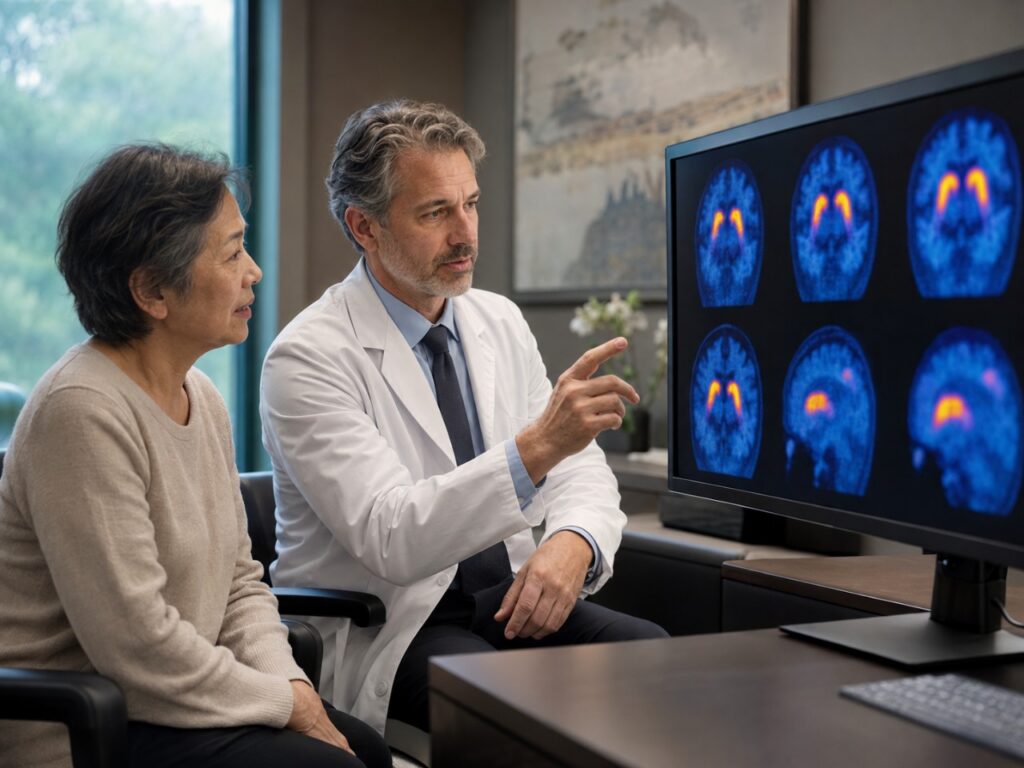
In uncertain cases, dopamine transporter imaging such as a DaTscan may provide additional information. DaTscan evaluates the integrity of the presynaptic nigrostriatal dopaminergic system. It can help determine whether there is evidence of a presynaptic dopamine deficit, particularly when the clinical presentation is unclear.
But it is important to understand what the test does not tell us.
A DaTscan does not directly demonstrate Parkinson’s specific pathology. Other neurodegenerative forms of parkinsonism may also produce abnormalities in dopamine transporter imaging.
A 2024 neuropathological validation study published in Neurology reinforced this distinction. Dopamine transporter imaging showed strong sensitivity for presynaptic dopaminergic parkinsonism, but its ability to distinguish among different causes of parkinsonism was more limited.
That is why the biological question matters.
Are we trying to determine whether the dopaminergic system is impaired?
Or are we looking for evidence of a specific pathological protein?
Those are not the same question.
Syn One and the Search for Parkinson’s Biology
For some time now, we have also offered the Syn One Test at Sharlin Health and Neurology.
Syn One uses small punch biopsies of the skin to look for phosphorylated alpha-synuclein within cutaneous nerve fibers. Abnormal alpha-synuclein accumulation is an important pathological feature of Parkinson’s disease and several related disorders collectively known as synucleinopathies.
The distinction between Syn One and DaTscan is therefore important.
DaTscan asks whether there is evidence of presynaptic dopaminergic dysfunction. Syn One asks whether phosphorylated alpha-synuclein can be demonstrated within peripheral nerve fibers.
Neither test replaces a careful history and neurological examination, and the two tests should not be thought of as interchangeable.
They provide different pieces of biological information.
What the Research on Skin Biopsy Shows
A major 2024 study published in JAMA examined skin biopsy detection of phosphorylated alpha synuclein in people with clinically established synucleinopathies.
Among participants included in the primary analysis, phosphorylated alpha-synuclein was detected in:
- 92.7 percent of participants with Parkinson’s disease
- 98.2 percent of participants with multiple system atrophy
- 96 percent of participants with dementia with Lewy bodies
- 100 percent of participants with pure autonomic failure
It was detected in 3.3 percent of control participants without a known synucleinopathy.
Those results are encouraging, but they need to be interpreted correctly.
A positive skin biopsy does not automatically mean that a patient has Parkinson’s disease specifically. The study demonstrated phosphorylated alpha synuclein across several synucleinopathies.
The test may therefore add biological evidence that a synucleinopathy is present, but the physician still has to determine how that finding fits with the patient’s symptoms, examination, history, imaging, and other information.
That is precision medicine in practice.
It is not about replacing clinical judgment with a test. It is about giving clinical judgment more biological information to work with.
From Detecting Parkinson’s Biology to Measuring Disease Activity
Confirming that Parkinson’s related biology is present is only one step.
The next challenge is much more difficult:
Can we measure how that biology changes over time? This is where Parkinson’s research becomes particularly interesting.
A diagnostic biomarker answers a question such as, “Is this biological abnormality present?”
A quantitative or monitoring biomarker would ideally help answer additional questions:
How much disease activity is present? Is it changing? How quickly is it changing?
And is a therapeutic intervention altering that biological process?
At the moment, we do not have a routine blood test in clinical practice that can reliably answer all of those questions for Parkinson’s disease.
But researchers are working toward that goal.
Developing Blood-Based Biomarkers for Parkinson’s Disease
Octave Bioscience, the company whose Multiple Sclerosis Disease Activity platform we have used in our MS patients, is developing a blood-based, multi-protein biomarker panel for Parkinson’s disease.
The Michael J. Fox Foundation awarded Octave a $10 million grant in 2023 to support the discovery, development, and validation of a biomarker panel intended to measure Parkinson’s disease activity and progression. The stated research goals include studying disease activity, progression, staging, biological subtypes, and potentially treatment response.
Importantly, this remains a technology in development.
It is not yet the Parkinson’s equivalent of a commercially available MS disease activity test.
But the goal itself tells us something important about where Parkinson’s research is heading.
The project draws on deeply characterized biospecimens and data from PPMI, which was originally known as the Parkinson’s Progression Markers Initiative. In May 2026, The Michael J. Fox Foundation renamed it the Parkinson’s Precision Medicine Initiative, reflecting its broader focus on defining Parkinson’s through biology and developing more individualized approaches to research and treatment.
PPMI has followed people with and without Parkinson’s over time while collecting clinical information, imaging, biospecimens, genetic data, and other biological measurements.
That type of longitudinal dataset is exactly what is needed if we hope to determine which biomarkers correspond to disease onset, progression, or therapeutic response.
What Would Quantitative Parkinson’s Biomarkers Change?
Today, when I follow a patient with Parkinson’s disease, I may track tremor, rigidity, gait, balance, cognition, sleep, autonomic symptoms, medication requirements, exercise capacity, and standardized Parkinson’s rating scales. All of those measurements matter. None should disappear.
But imagine being able to add another layer.
We obtain a biological measurement before beginning a therapeutic program and establish a baseline. Several months later, we repeat it. Perhaps the patient feels better, and the biological markers move in what research has established as a favorable direction.
Perhaps the patient feels unchanged while certain biological measurements change.
Or perhaps the patient reports symptomatic improvement while biomarkers suggest that an underlying disease process remains active.
Each situation would raise a different set of clinical questions.
Now imagine that two patients who look remarkably similar in the examination room have significantly different biological profiles. If that turns out to be the case, why would we automatically assume they should receive exactly the same therapeutic strategy?
This is where precision medicine ultimately leads.
But before we can use biomarkers this way, they have to be validated against meaningful clinical outcomes.
That is the difficult part.
Measuring Whether a Treatment Changes Parkinson’s Biology
Recent Parkinson’s research provides an early example of what biological treatment monitoring might eventually look like.
In February 2026, researchers published results from the Phase 2a 201 Trial of risvodetinib, an investigational c-Abl kinase inhibitor studied in people with early, untreated Parkinson’s disease.
The randomized trial enrolled 137 participants and evaluated three doses of risvodetinib against placebo. The trial met its primary safety and tolerability endpoints.
The trial did not, however, demonstrate a statistically significant benefit on its first hierarchical clinical efficacy measure, the combined Parts II and III score of the Movement Disorder Society Unified Parkinson’s Disease Rating Scale. Longer studies would be necessary to determine whether the therapy provides meaningful clinical benefit.
That limitation is important. But another aspect of the trial interests me from a precision medicine perspective.
Skin Biopsies as an Exploratory Treatment Biomarker
A subset of trial participants underwent skin biopsies at baseline and again after 12 weeks of treatment.
Researchers evaluated phosphorylated alpha-synuclein deposits within cutaneous nerve fibers. Their exploratory analysis suggested treatment-related reductions in alpha-synuclein pathology among some participants receiving risvodetinib.
The study authors were appropriately cautious.
They noted that it remains unknown whether changes in peripheral alpha synuclein pathology correspond to what is occurring within the brain, whether those changes predict disease progression, or whether they can predict meaningful treatment success.
That caution matters.
The study did not prove that reducing phosphorylated alpha-synuclein in the skin slows Parkinson’s disease. But to me, the larger significance is the question researchers were able to ask: Did the treatment produce a measurable biological change associated with Parkinson’s pathology?
That is a fundamentally different endpoint from simply asking whether a patient’s tremor improved over 12 weeks.
The future will require us to connect both. Did the patient improve clinically? Did the biology change? And, most importantly, does changing that biology predict a better outcome for the patient?
Precision Medicine Is Not About Ordering More Tests
This distinction is important because precision medicine should never become synonymous with ordering a large number of laboratory studies.
More testing does not automatically mean better medicine. A biomarker has value when it helps answer a clinically meaningful question.
Will this test help clarify the diagnosis?
Will it provide information that another test cannot?
Could it help distinguish one biological process from another?
Has it been validated for monitoring disease progression?
Could the result reasonably change what we recommend?
Do we understand what an abnormal result actually means?
If the answer to those questions is no, additional testing may simply produce more data without producing better decisions. That is not precision medicine.
Precision medicine requires selecting the right measurement for the right question and understanding the limits of what that measurement can tell us.
Parkinson’s Disease May Not Be One Biological Disease
The most interesting possibility is that biomarkers may eventually do more than tell us whether Parkinson’s disease is present.
They may help us better define its biological heterogeneity.
The clinical label “Parkinson’s disease” describes patients who can look similar in the examination room while progressing differently, developing different nonmotor symptoms, responding differently to treatments, and carrying different genetic or molecular features.
Researchers are increasingly asking whether those differences reflect biologically meaningful subtypes.
A 2024 International Parkinson and Movement Disorder Society consensus paper argued that Parkinson’s subtyping should ultimately serve specific precision medicine goals, including predicting progression, predicting treatment response, and identifying targets for disease-modifying therapy.
Other researchers have proposed biological research classifications incorporating alpha-synuclein pathology, neurodegeneration, and genetics. One example is the SynNeurGe framework published in 2024.
Importantly, its authors emphasized that such criteria are intended for research at this stage, not as a replacement for routine clinical diagnostic criteria.
That distinction should not be lost.
We are not yet at a point where a neurologist can take a collection of blood biomarkers and confidently say, “This patient has this biological subtype of Parkinson’s disease and therefore requires this particular treatment.”
But the scientific direction is becoming clearer.
Different patients may have different contributions from alpha-synuclein pathology, genetics, mitochondrial dysfunction, lysosomal biology, neuroinflammation, or other disease mechanisms. These processes may overlap considerably, and we do not yet know how to translate all of them into routine treatment selection.
The goal is not to create categories simply for the sake of categorizing patients.
The goal is to identify differences that matter.
From Precision Diagnosis to Precision Treatment
This leads to what I believe is the real objective.
Precision diagnosis asks: “What disease does this patient have?”
Precision treatment asks: “What appears to be driving this disease in this particular patient, and which intervention is most likely to change it?”
Those are very different levels of medicine. The first depends on recognizing a syndrome. The second requires understanding biology deeply enough to connect a specific patient to a specific intervention.
That is where oncology has been moving for years. Neurology is beginning to move in the same direction, although neurodegenerative diseases present their own scientific challenges.
For Parkinson’s disease, getting there will require much more than one blood test.
We will likely need combinations of clinical information, imaging, genetics, protein biomarkers, physiological measurements, digital outcome data, and longitudinal observation.
The key point is that these measurements must lead to better clinical decisions.
Otherwise, they are simply measurements.
Frequently Asked Questions About Precision Medicine and Parkinson’s Disease
1. Is There a Blood Test for Parkinson’s Disease?
There is currently no routine blood test that, by itself, can diagnose Parkinson’s disease or reliably measure disease activity and progression in standard clinical practice.
Researchers are investigating several blood-based biomarker approaches. Octave Bioscience, for example, is developing a multi-protein Parkinson’s biomarker panel with support from The Michael J. Fox Foundation, but that platform remains in development.
2. What Does a DaTscan Show?
A DaTscan assesses dopamine transporter activity within the striatum and can provide evidence of presynaptic dopaminergic dysfunction.
It can be useful when clinicians are trying to distinguish neurodegenerative parkinsonism from conditions without the same type of dopaminergic deficit. However, it does not directly identify alpha synuclein pathology and cannot reliably distinguish Parkinson’s disease from every other neurodegenerative form of parkinsonism.
3. What Does the Syn One Test Look For?
The Syn One Test evaluates skin biopsy samples for phosphorylated alpha-synuclein within cutaneous nerve fibers.
A large 2024 study found high rates of phosphorylated alpha synuclein detection in patients with Parkinson’s disease and several other clinically established synucleinopathies. For that reason, the result must be interpreted within the broader clinical picture rather than treated as a Parkinson’s specific answer by itself.
4. Does Syn One Replace a Neurological Examination?
No. Parkinson’s disease remains fundamentally a clinical diagnosis, and neurological history and examination remain central.
Biomarker testing may provide additional evidence in selected patients, particularly when the diagnosis or underlying biology is uncertain.
5. Can Biomarkers Tell Whether Parkinson’s Treatment Is Working?
Not reliably in routine clinical practice yet. Researchers are studying biomarkers that could potentially measure disease progression or biological treatment response.
The 2026 risvodetinib trial showed that changes in phosphorylated alpha-synuclein in skin can be measured experimentally over time, but researchers have not yet established that these changes predict clinical benefit or slower Parkinson’s disease progression.
6. Why Is Biological Subtyping Important in Parkinson’s Disease?
Patients with Parkinson’s disease can differ substantially in genetics, symptoms, disease progression, pathology, and treatment response.
Researchers hope that identifying biologically meaningful subtypes may eventually improve predictions about progression, identify therapeutic targets, and help determine which patients are most likely to respond to particular treatments. That remains an active area of research rather than an established clinical system.
Conclusion: Measuring the Trajectory of Parkinson’s Disease
At Sharlin Health and Neurology, our goal is not simply to diagnose Parkinson’s disease and manage symptoms.
We want to understand the individual patient as completely as the available science allows, measure what can meaningfully be measured, and use those measurements to make better decisions over time.
We are not yet at the point where a simple Parkinson’s blood test can tell us everything we want to know. We cannot yet look at one biomarker and reliably determine exactly how quickly a patient’s disease will progress, whether a particular intervention will alter that progression, or which treatment is biologically ideal for that individual.
The emerging biomarkers still require validation, and we have to be careful not to claim more from them than the evidence supports. But the direction is increasingly clear. Medicine has spent much of the last century becoming increasingly sophisticated at naming disease.
The next phase of medicine will increasingly be about measuring disease, understanding its biology, and determining whether our therapeutic strategies are actually altering meaningful aspects of that biology.
For Parkinson’s disease, the important question may eventually become much more than:
“Does this patient have Parkinson’s disease?”
We may increasingly be able to ask:
“What is happening biologically?”
“How is it changing over time?”
“What is driving the disease in this particular patient?”
“And is what we are doing actually changing the trajectory?”
That is the promise of precision medicine. And ultimately, the most important measure of any therapeutic strategy is not whether it sounds promising. It is whether it produces meaningful benefit for the patient.
